ATK Gear Review: Mice, Keyboards, and Who They're For
Product photos courtesy of ATK Gear
ATK Gear has built its name in competitive esports rather than mainstream retail — its mice and keyboards are backed by VALORANT world champions as brand ambassadors and a Tier 1 CS2 tournament sponsorship, and the specs on its flagship gear read like a spec sheet built for tournament players first, everyone else second. But "esports peripheral brand" covers mice under 40 grams and 65%/75% Hall Effect keyboards with sub-millimeter actuation, and picking the wrong one for your grip or typing style is an easy mistake. Here's what ATK's current mouse and keyboard lineups actually offer, based on the specs listed on ATK's own site, and which model fits which kind of player.
ATK Gear in Brief: Who Makes These Peripherals
ATK Gear Global Limited is headquartered in Hong Kong, registered at Unit 1603, 16/F The L Plaza, 367–375 Queen's Road Central, Sheung Wan, and it positions itself around "redefining esports peripherals with cutting-edge innovation" rather than the broader mainstream gaming-accessory market. That positioning shows up most clearly in its sponsorships: ATK has signed VALORANT world champions Aspas and Chronicle as global brand ambassadors — Aspas fronting the keyboard line, Chronicle the mouse line — and the company is an official partner of StarLadder StarSeries Fall 2026, the 20th-anniversary edition of the Tier 1 CS2 event carrying a $500,000 prize pool. ATK also backs Leviatán Esports (2026 Masters London champions), BBL Esports (VCT EMEA Kickoff 2026 champions), and PCIFIC Esports, home to world champion cNed. Beyond hardware, ATK runs ATK HUB, a device-management platform it says serves more than 8 million monthly active users, and its site hosts a technical blog covering topics like lift-off distance (LOD) tuning and DPI calibration — a level of documentation depth that's unusual for a peripheral brand this size and worth checking if you like understanding the mechanism behind a spec rather than just trusting the marketing copy.
The Mouse Lineup: Blazing Sky Zero and Blazing Sky Phantom
ATK's two flagship mice split along a familiar competitive-mouse trade-off: raw lightness versus a slightly heavier, more structural build. Both use ATK's "All-New Nano Coating," a 300mAh battery rated for roughly 200 hours at 1000Hz polling, and dual 8,000Hz polling in both wired and 2.4GHz wireless modes — a spec that used to be wired-only on most gaming mice.
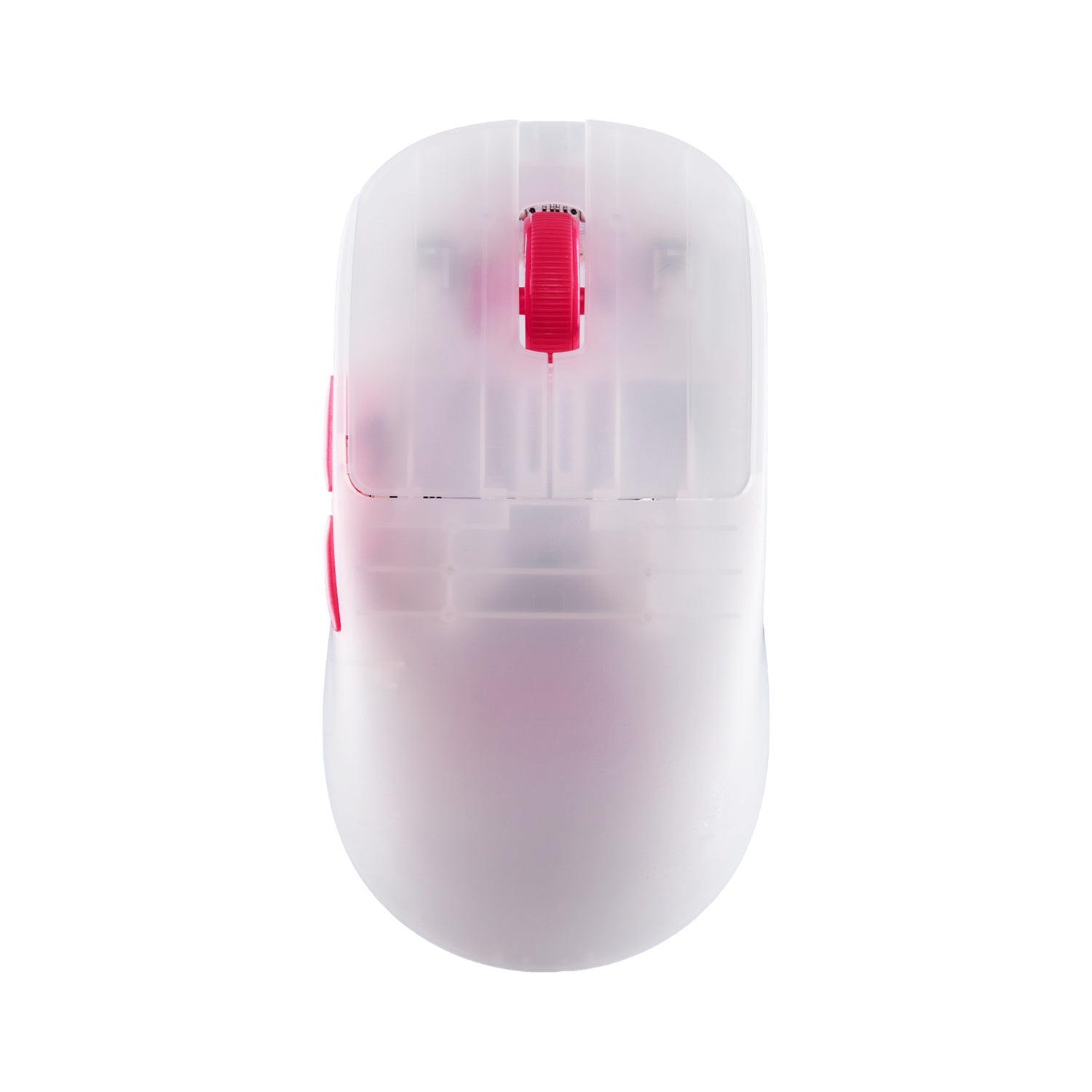
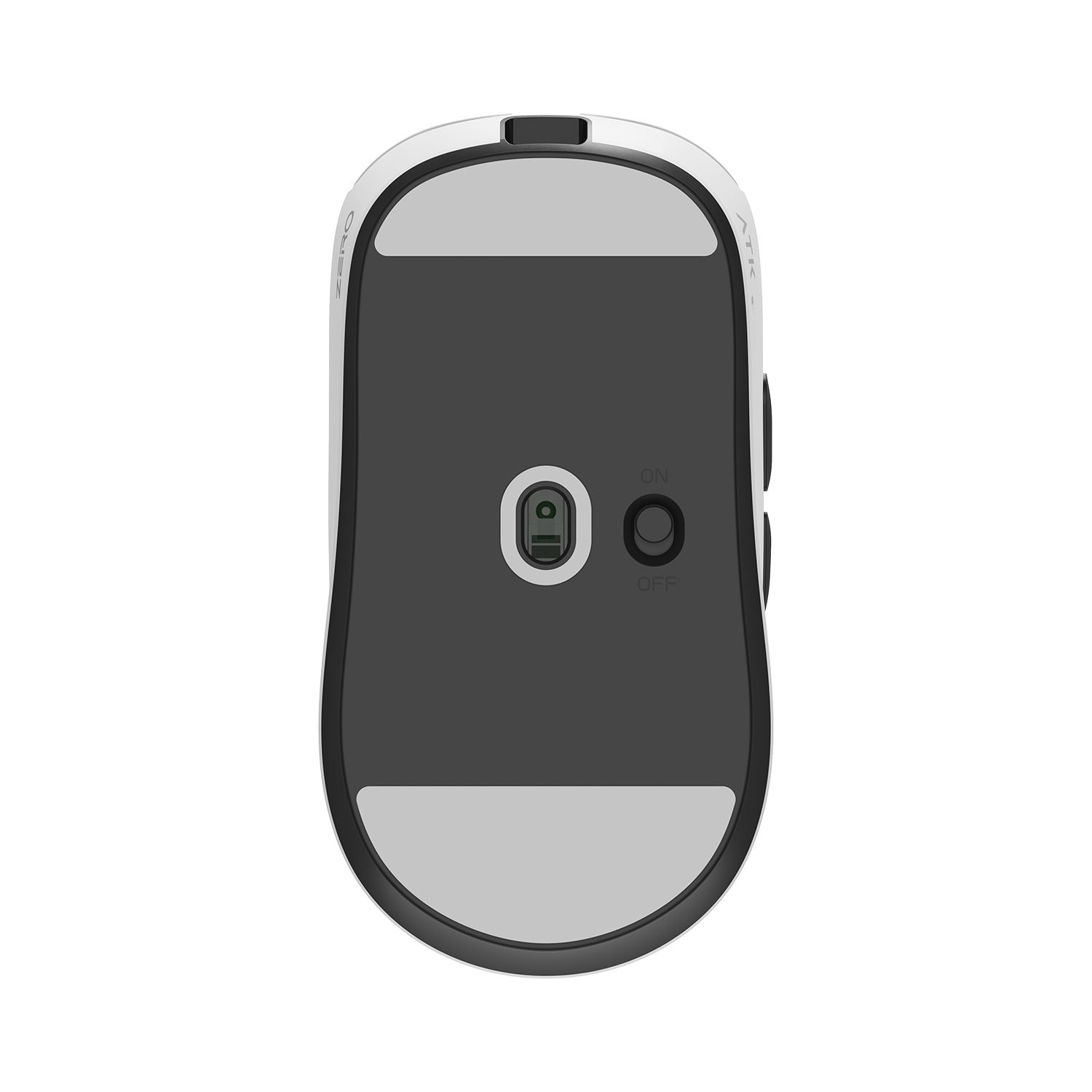
The ATK Blazing Sky Zero is the ultralight of the two at just 39±3g, built around a PAW3950 Ultra sensor with a DPI range up to 42,000, ATK custom optical switches, a TTC gold-plated scroll wheel, and an Nordic 54L15 MCU driving 0.181ms click latency. It measures 120.1 × 63.2 × 38.1mm in a symmetrical shape suited to claw, palm, or fingertip grips, and it currently sells for $69.98 (down from $89.98). If your priority is shaving every possible gram for fast flicks, the ATK Zero is the lighter of the two by a meaningful five grams.
Product photos courtesy of ATK Gear
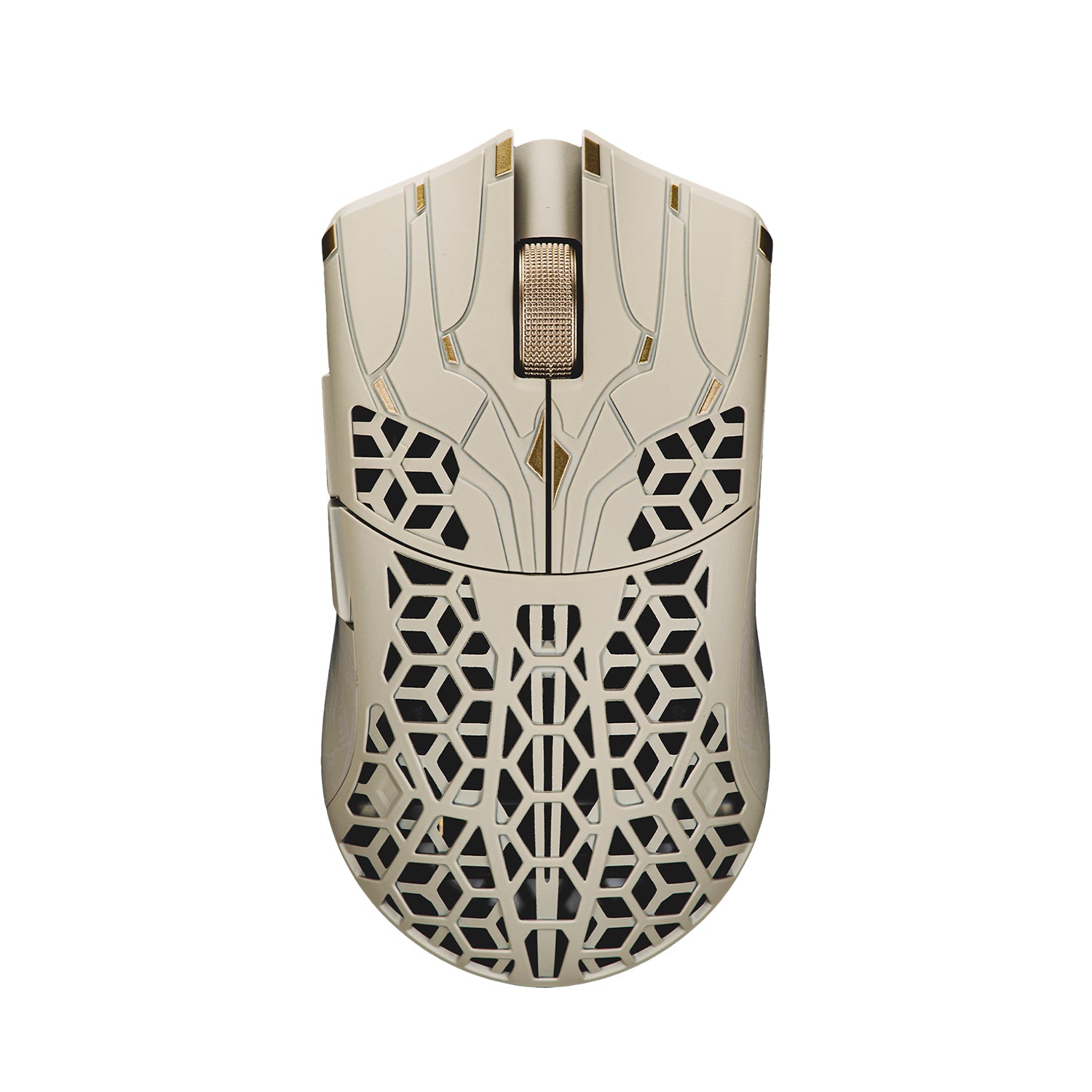
The ATK Blazing Sky Phantom trades a small amount of weight for a hollow carbon-fiber composite shell with a staggered cutout design, landing at 44±3g. It steps up to a PAW3955 Master sensor — DPI range up to 50,000 with 850 IPS tracking and 75G acceleration — Omron optical switches, a Raesha optical encoder scroll wheel, and 0.174ms click latency, marginally faster than the Zero despite the added weight. It's currently listed for pre-order at $99.98 (down from $119.98) in four colorways: Dune Sand, Verge Blue, Eon Black, and Prime White.
Product photos courtesy of ATK Gear
| Model | Best for | Weight | Sensor | Polling | Price |
|---|---|---|---|---|---|
| Blazing Sky Zero | Lightest possible build | 39±3g | PAW3950 Ultra | Dual 8,000Hz | $69.98 |
| Blazing Sky Phantom | Structured carbon-fiber grip | 44±3g | PAW3955 Master | Dual 8,000Hz | $99.98 |
The Keyboard Lineup: RS6 and RS7 Hall Effect Series
ATK's keyboards run on magnetic Hall Effect switches rather than traditional mechanical contacts, which lets the board measure a key's exact position rather than just registering an on/off click. Across both series, that translates into rapid trigger precision adjustable in 0.001mm steps across a 0.001–3.3mm range, 8,000Hz polling, an N-Key rollover scan rate up to 32KHz (256KHz in an "Extreme" mode), and latency as low as 0.08ms — plus per-key software control over deadzone, SOCD, and rapid trigger behavior through ATK HUB.
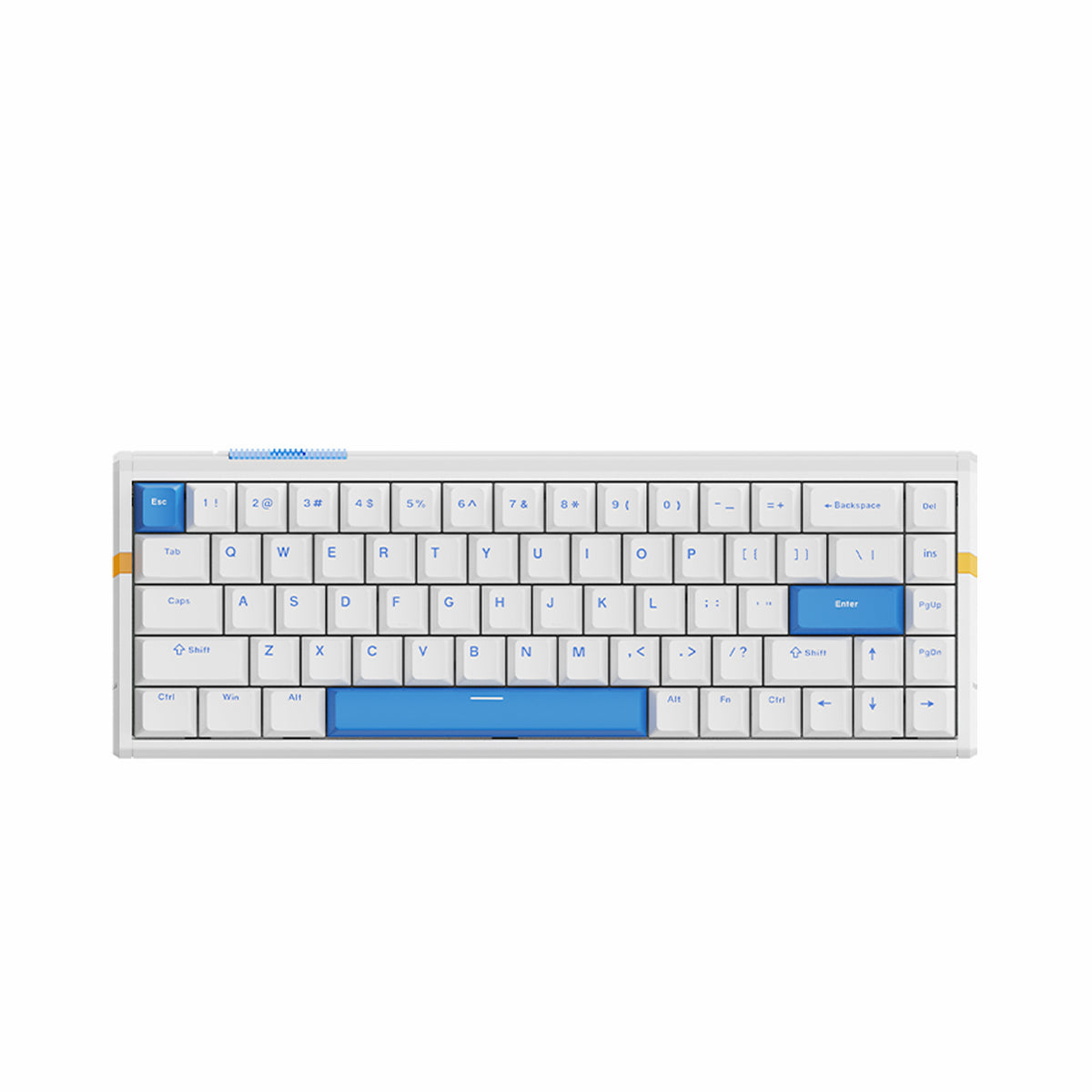
The RS6 series is ATK's 65% lineup, running from the plastic-cased RS63 Air and RS6 Air ($59.98–$69.98) up through the aluminum RS6 and RS6+ ($99.98–$109.98) to the flagship RS6 Ultra with TTC RGB Magneto switches. Case material is the main lever here: the Air models keep things light and accessible, while the aluminum builds add a denser typing feel and, on the RS6+, five-layer acoustic padding for a noticeably different sound profile. If a compact 65% layout with adjustable actuation is what you're after, the RS6 lineup is the more budget-flexible entry point into ATK's Hall Effect keyboards.
Product photos courtesy of ATK Gear
The RS7 series steps up to a 75% layout — keeping the function row while still leaving more mousing room than a full-size board — across four sub-models: the RS7 Air (from $69.98, ABS with aluminum accents), RS7 Turbo (from $104.98, aluminum top), RS7 V2 (from $139.98, full CNC aluminum with a dual "TOP & Core-Flex" structure), and RS7 eSports (from $89.98). Switch options vary by model, down to a Leviatán-branded "Siren" magnetic switch on the RS7 V2 — a direct nod to ATK's esports sponsorship rather than a generic OEM part.
Who Should Buy What
If pure weight is the deciding factor — fast-flick shooters, high-sensitivity players, or anyone who's felt the difference a few grams makes over a long session — the Blazing Sky Zero's 39g shell and PAW3950 Ultra sensor make it the more purpose-built pick. If you'd rather trade a little weight for a mouse that feels more substantial in hand and want the marginally faster PAW3955 Master sensor, the Blazing Sky Phantom's carbon-fiber build is the better fit, though it's currently pre-order only. On the keyboard side, players who want maximum desk space for mouse movement should look at the RS6's 65% layout, while anyone who still wants dedicated function keys without going full-size will get more use out of the RS7's 75% form factor. Budget-conscious buyers on either keyboard line should start with the Air models; players chasing the most premium typing feel and acoustics should look at the RS6+ or RS7 V2.
Pricing, Availability, and What to Check Before Buying
Nearly everything in ATK's current lineup ships at a discount off its listed regular price — the Zero at 22% off, the Phantom at 17% off, and keyboard models ranging from 19% to 40% off — so it's worth confirming the live price against the regular price shown on the product page before assuming a "sale" reflects a genuinely lower long-term price. The Blazing Sky Phantom is listed as pre-order at the time of writing, so factor in a longer ship window than an in-stock item. Because ATK's Hall Effect keyboards expose their rapid trigger and actuation settings through ATK HUB software, it's also worth checking that the specific model and switch combination you're ordering supports the adjustment range you actually plan to use — the RS7 Turbo's 0.01mm step precision, for example, is coarser than the 0.001mm steps on the RS7 Air and V2.
Bottom Line
ATK Gear isn't a general-purpose peripheral brand with esports branding bolted on — the sponsorships, the sub-40g mouse builds, and the sub-millimeter Hall Effect keyboards all point at the same competitive-player audience, and the lineup is priced close enough together that the real decision is about grip weight preference and keyboard layout rather than budget. Match the mouse to how much weight you're willing to trade for sensor ceiling, and the keyboard to how much desk space you need back, and the lineup makes more sense than judging any one product in isolation. You can check current pricing, colorways, and availability across the full range on ATK Gear's own site.
Reviewed by OmniReview
OmniReview is the editorial team behind Gear Rescue Guide. We build every guide from manufacturer documentation, published test standards, and long-term owner reports, and add our own hands-on impressions whenever we've had the chance to use the gear directly — we don't claim to have tested every product we cover. See our How We Review page for the full process.