Wired vs Wireless Headphones: Does the Cable Still Matter in 2026?
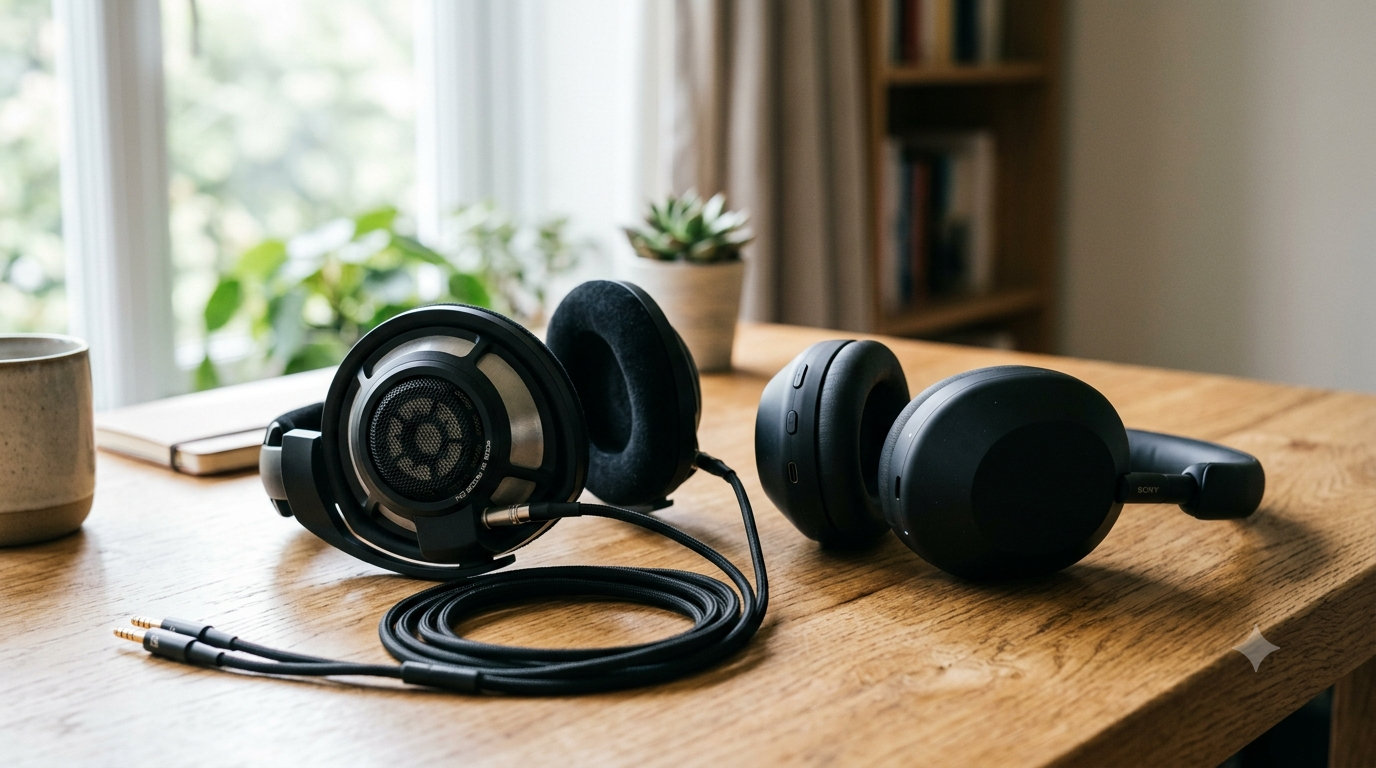
For years the answer was simple: if you cared about sound quality, you used a cable. Wireless was for convenience, and you paid for that convenience with compressed audio. That gap has narrowed considerably — but it hasn't closed entirely. Here's an honest look at where wired and wireless actually stand now.
What Changed in Wireless Audio
Modern Bluetooth codecs have improved substantially over the basic SBC standard that defined early wireless audio. Higher-bandwidth codecs can now transmit meaningfully more data, and the best wireless headphones use custom digital signal processing to compensate for the limitations of the transmission itself.
For most listeners, with most music, in most environments, the difference between a good wireless connection and a wired one is now small enough to be inaudible during normal listening.
Where Wired Still Wins
- Uncompressed signal path. A wired connection transmits the full audio signal without any compression or re-encoding. No matter how good a wireless codec is, it's still working within a bandwidth limit that a cable simply doesn't have.
- Zero latency. This matters enormously for music production, video editing, and competitive gaming, where even small delays between what you see and what you hear become a real problem.
- No battery dependency. A wired pair works forever. Wireless headphones have a finite battery lifespan — after a few years of daily charge cycles, capacity degrades, and on many models the battery isn't user-replaceable (see our guide to headphone care and longevity for how to slow that degradation).
- Codec consistency. Wireless quality depends on both the headphones and the source device supporting the same high-quality codec. If your phone doesn't support the codec your headphones use, you fall back to a lower-quality connection without necessarily realizing it.
- Higher ceiling at the same price. Wireless headphones spend part of their cost on the battery, chipset, ANC hardware, and antennas. At any given price point, a wired pair typically spends more of that budget on drivers and build quality.
Where Wireless Wins
- Practical freedom. No cable to snag, no headphone jack required, no untangling. For commuting, workouts, and moving around a home or office, this is not a small advantage.
- Integrated features. ANC, transparency mode, adaptive EQ, multipoint pairing, and touch controls all require the onboard electronics that wireless headphones already have.
- Device compatibility. Many phones no longer include a headphone jack, making wireless the default path unless you carry a dongle.
If noise cancellation is the deciding factor, see our breakdown of ANC vs passive noise isolation for airplane travel for when ANC actually earns its keep and when passive isolation does the job just as well.
The Hybrid Answer Most People Should Consider
A significant number of premium wireless headphones now include a wired option — a 3.5mm or USB-C input that bypasses Bluetooth entirely. This is worth prioritizing when comparing models, because it means:
- You can use them wirelessly day-to-day
- Plug in for critical listening, recording, or gaming where latency matters
- Keep using them when the battery dies
If you only want one pair, a wireless model with a proper wired mode covers nearly every scenario.
How to Decide
| Your priority | Better choice |
|---|---|
| Music production, mixing, editing | Wired (latency and signal integrity) |
| Commuting, gym, general daily use | Wireless |
| Critical home listening on a budget | Wired (more driver quality per dollar) |
| Competitive gaming | Wired, or wireless with a low-latency dedicated dongle |
| One pair for everything | Wireless with a wired backup input |
Ear cup design is a related fork in the road once you've settled the wired-vs-wireless question — see our comparison of open-back vs closed-back headphones for how isolation and soundstage factor in. And if budget is the real constraint, see headphones by budget for where wired options typically deliver more driver quality per dollar than their wireless equivalents.
Final Thoughts
The wireless quality gap is now small enough that convenience wins for most everyday listening. Wired still holds real advantages in latency, signal integrity, longevity, and price-to-performance — which is why studios and audiophiles haven't abandoned cables. For most buyers, the smartest move isn't picking a side but choosing wireless headphones that can also run wired when it matters.
Reviewed by OmniReview
OmniReview is the editorial team behind Gear Rescue Guide. We build every guide from manufacturer documentation, published test standards, and long-term owner reports, and add our own hands-on impressions whenever we've had the chance to use the gear directly — we don't claim to have tested every product we cover. See our How We Review page for the full process.