How Accurate Is VO2 Max on a Smartwatch?
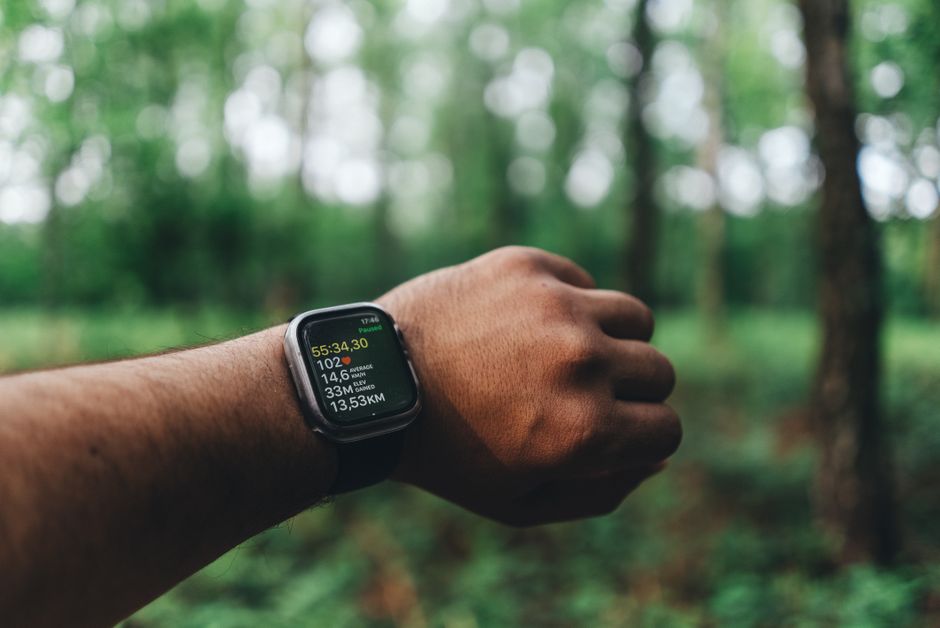
Photo: Omar Ramadan / Pexels
Your watch shows a VO2 max estimate that ticked up two points after a single good run, and you're wondering whether your aerobic fitness genuinely improved that fast — or whether the number means much at all. It's worth understanding that a watch isn't measuring VO2 max the way a lab does; it's estimating it, and the difference matters for how much weight to put on any single reading.
What VO2 Max Actually Is
True VO2 max is measured in an exercise physiology lab using a graded exercise test: you run or cycle at increasing intensity to exhaustion while wearing a mask connected to a metabolic cart that directly measures how much oxygen you consume and how much carbon dioxide you produce. This is a direct physiological measurement and the actual clinical gold standard.
What Your Watch Is Actually Doing
A smartwatch has no way to directly measure gas exchange. Instead, it estimates VO2 max using a model that combines your heart rate response to pace or effort during runs with personal data — age, sex, resting heart rate, and sometimes body weight — run through a regression algorithm that was originally validated against lab-measured VO2 max data across a population sample, then applied to your individual training data. It's a prediction built on a pattern, not a direct measurement of your physiology.
Why the Estimate Is Sometimes Off
The model works by relating your heart rate to your pace, so anything that decouples the normal relationship between the two throws the estimate off for that session: uneven or hilly terrain, extreme heat, dehydration, illness, a poorly seated heart rate sensor, or a treadmill run without GPS pace data. It also needs a reasonable amount of consistent outdoor running data — typically several weeks of steady runs — before it converges toward a more personalized estimate rather than relying heavily on generic population defaults. Early estimates on a new watch, or estimates from someone who runs inconsistently, tend to be noisier and less reliable.
Published validation studies generally show consumer wearables landing within a few points of lab-measured VO2 max on average for consistent runners, but individual error can be considerably larger, and accuracy tends to degrade at the very high and very low ends of the fitness spectrum, where the underlying model has less representative population data.
Why a Single-Run Jump Isn't Real
VO2 max, as an actual physiological trait, does not meaningfully change from one workout — genuine aerobic fitness adaptations happen over weeks and months of consistent training, not overnight. A sudden jump or drop after a single run almost always reflects noise in the heart-rate-to-pace model for that specific session (better pacing, cooler weather, cleaner HR signal), not a real change in your fitness. Treating single-session changes as meaningful is the most common way people misread this metric.
How to Actually Use the Number
Look at the trend over a full training block — weeks to months — rather than reacting to any individual session. Make sure your heart rate sensor has good skin contact and that you're running outdoors with GPS enabled for the most consistent data feeding the algorithm. If the number is trending steadily upward over a training cycle, that's a meaningful signal your aerobic base is improving; a single good or bad run moving the number by a point or two is not. For a broader look at choosing a wearable suited to structured training, see our complete fitness wearable buying guide.
When to Get an Actual Lab Test
If you need clinically valid VO2 max data — for a structured professional training program, sports science research, or a specific medical assessment — a wearable estimate is not a substitute for a metabolic cart test. For general fitness tracking, it isn't worth the cost or hassle.
Bottom Line
Treat your watch's VO2 max as a directional trend indicator over a training block, not a precise physiological measurement — it's useful for confirming your aerobic fitness is moving in the right direction over time. Don't read into single-run jumps, and don't pay for a lab test unless you have a specific professional or medical reason that requires clinical-grade precision.
Reviewed by OmniReview
OmniReview is the editorial team behind Gear Rescue Guide. We build every guide from manufacturer documentation, published test standards, and long-term owner reports, and add our own hands-on impressions whenever we've had the chance to use the gear directly — we don't claim to have tested every product we cover. See our How We Review page for the full process.